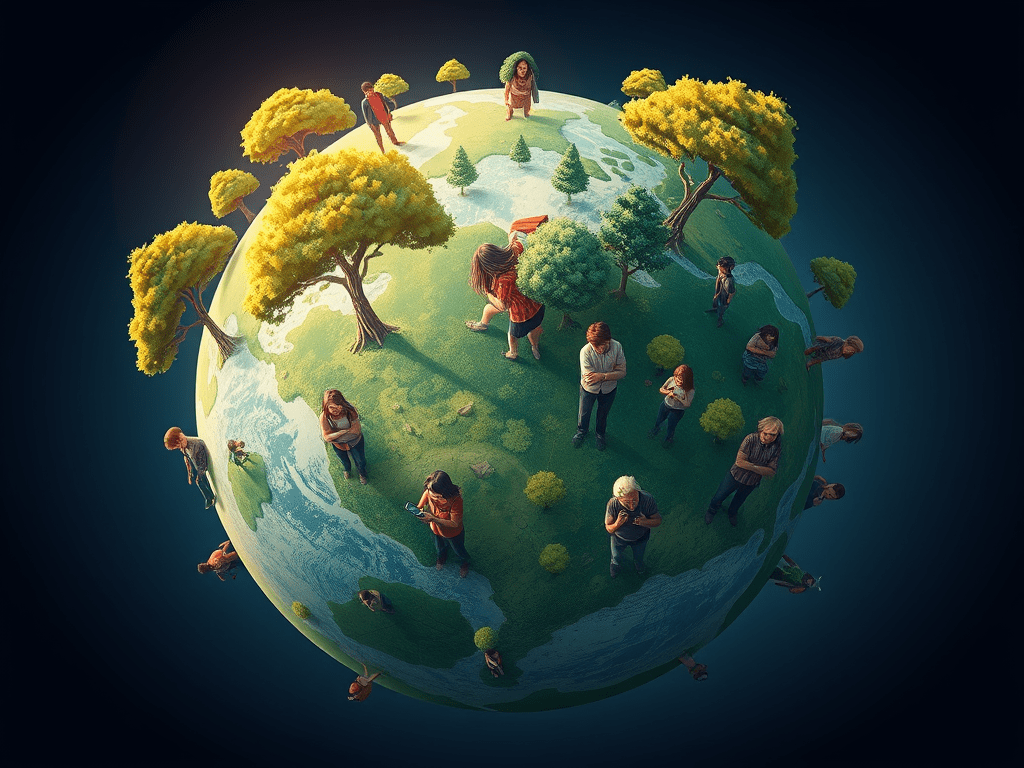
For the most part, psychologists tend to study individuals. And, for this reason, most nature connection research has tended to focus on the specific factors in individual’s lives (e.g., time outside, age, screen time, etc) that influence individual’s levels of nature connectedness. This is, of course, very important as the world is made up of individuals. However, it neglects the bigger question of how societal factors—those factors that apply to all of us who live in the same place—impact our shared level of nature connectedness.
Therefore, we sought to use a publicly available dataset containing nature connectedness scores for over 60 countries and test the association between those scores and a variety of country-level indicators (many derived from worldbank) that theory would suggest should predict nature connectedness.
Some of these indicators are what we would call objective. For example, percentage of the population that lives in urban areas or the ease-of-business rank based on how ‘friendly’ a given country’s laws were to businesses. Both of these are things that can (and are) measured by outside observers and are not consciously reported by the society itself. Other indicators were what would be best called subjective—and largely came from the world values survey. For example, ratings from a large sample of participants in each country related to how important science is versus faith and how many individuals report being religious. These, unlike the objective indicators, require individuals in the society to tell us something about themselves.
We used these, and other indicators, to predict country-level nature connectedness scores and found that ease of doing business and % urban population were the two most significant objective predictors of nature connectedness (both predicting nature connectedness negatively!); religiosity and valuing faith more than science were the most significant subjective predictors (both predicting nature connectedness positively).
The most intriguing thing about these findings is that it paints a picture in which development is potentially antithetical to having a strong relationship with nature—or at least too much development may be.
It is also worth noting that, in the course of these analyses, we noticed that progress toward the UN sustainable development goals (SDGs) was not only negatively correlated with biodiversity, but was also negatively correlated with nature connectedness suggesting that the SDGs might not be working as we would hope—as countries doing more ‘sustainable development’ had much lower biodiversity and were more disconnected with nature!
For now, I wont speculate too much. Suffice it to say that this research raises real questions about what is necessary if we really want to take repairing the human–nature relationship seriously. After all, in 2020, the UN Secretary General declared that ‘Now is the time to transform humankind’s relationship with the natural world’ (UN Climate Change News, 2020). Perhaps we should put our money where our mouth is.
If nothing else, this highlights that efforts to repair the human–nature relationship are unlikely to succeed if we dont also pay attention to the cultural context in which those relationships sit!
You can read more here:
Richardson, M., Lengieza, M. L., White, M. P., Tran, U. S., Voracek, M., Stieger, S., & Swami, V. (2025). Macro-level determinants of nature connectedness: An exploratory analysis of 61 countries. Ambio. https://doi.org/10.1007/s13280-025-02275-w
You might also be interested in reading this paper:
Lengieza, M. L., Swim, J. K., DeCoster, J., Guerriero, J. G., Saito, O., le Coent, P., Sella, L., Chien, H., Hérivaux, C., Rota, F. S., & Ragazzi, E. (2025). A Five-Culture Validation of the Environmental Value-Bases Scale: A Measure of Instrumental, Intrinsic, and Relational Environmental Values. Sustainability, 17(22), 10102. https://doi.org/10.3390/su172210102
 MeaningInNature.com
Leave a comment