In our most recently accepted paper, Mile’s Richardson, Jack Hughes, and myself did some more network analyses. This time, instead of focusing on emotions and activities, like we did in our first network study, we instead focused on the natural features that seemed to most distinguish highly nature-connective experiences from ones that were a bit ‘meh’.
In brief, we modeled a network based on people’s subjective reports of the types of features they encountered during four previous experiences and asked them to indicate how connected to nature that experience made them feel.
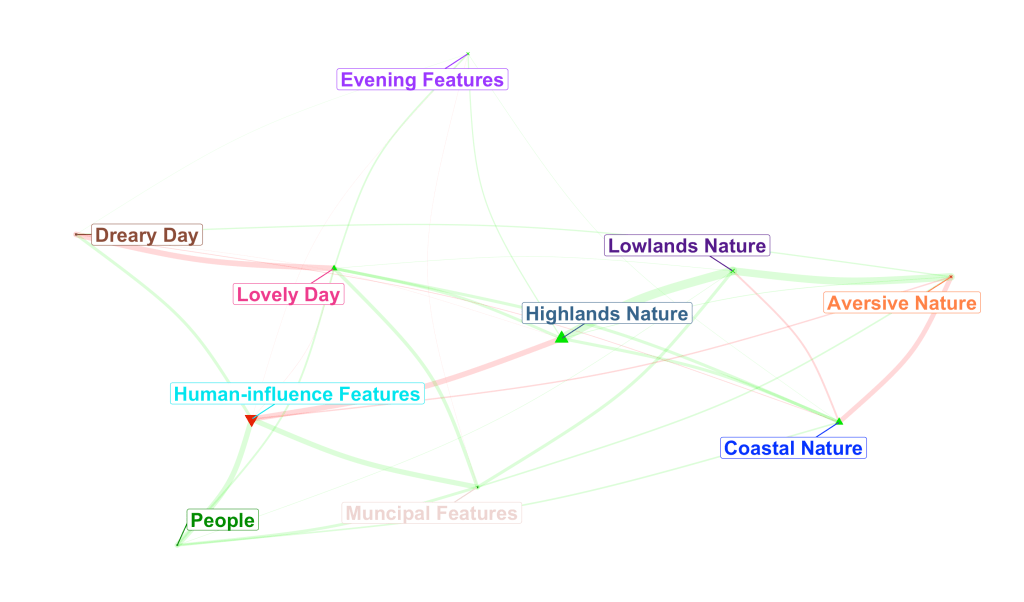
The detailed network produced a lot of nuanced findings, so, if you’re interested you should check out the full paper, but the aggregate network more or less revealed three note-worthy findings. First, and perhaps unsurprisingly, wilder nature (what we have dubbed as highlands nature) was uniquely important for nature connectedness. The more a given experience involved wildness, animals—both big and small—and mountainous or hilly features, the more connected to nature people felt. Second, the overt presence of human influence, whether it be trash, roads, cars, or buildings, were a unique negative influence on nature connectedness. Both of these findings, in particular, really highlight the need to create spaces where people can ‘check out’ of civilization for a bit so that the might be better able to connect to nature. In other words, we need more spaces reserved for wild nature. Finally, the third insight was that more ordinary nature (which we call lowlands nature) was not especially influential over and above the other features. In the simple network, some of these individual features were important (e.g., trails and meadows), but they seem to be much less influential compared to wild nature.
In sum, these findings strongly point to the need for both rewilding and dehuman-ing the nature around us.
An additional finding that is worth mentioning is that trails were especially central to the network. This means that trails showed a strong positive correlation with many other positive nodes in the network. In other words, when people were using trails, they were more likely to engage with other features that boost nature connectedness. Thus, it would seem that walking trails are incredibly important because they support engagement with a whole host of positive features. So, not only do we need more spaces reserved for wild nature—we also need more trails so that people can engage with those spaces…
…Does it sound like I am describing national parks? Because it sure sounds like it to me!
Read more here:
Lengieza, M. L., Richardson, M., & Hughes, J. P. (2025). Feature networks: The environmental features that are central to nature- connectedness experiences. Landscape and Urban Planning, 259, 105362. https://doi.org/10.1016/j.landurbplan.2025.105362
 MeaningInNature.com
Leave a comment