Nature connectedness is influenced by an incredibly complex array of factors, from the activities we engage in, to the features of the places in which we engage them (paper forthcoming), and even to the emotions those places and activities evoke (see this paper for a thorough review). To put it simply, there is a web—or a network—of factors that determine how connected to nature we feel in any given moment.
In our paper, Miles Richardson, Rosemary Aviste, and myself decided to lean into this perspective and treat nature connection experiences as the complex network of factors that they really are. In our first study, we focused on emotions. In the second, we focused on the pathways to nature connectedness. In both studies, we had participants think about four of their previous nature experiences that had made them feel differing levels of nature connectedness. They indicated the presence or absence of a range of emotions (Study 1) and activities (Study 2) and we analyzed the resulting data using the principles of social network analysis.
Emotions:
The emotion network (shown below) indicated that there were three broad clusters of emotions that tend to occur together during nature connection experiences. The easiest to understand was the negative emotion cluster (steel blue). The network shows us—because of all of the green bands connecting the negative emotions—that when one negative emotion occurred, many other negative emotions occurred.
There were also two clusters of positive emotions. The first were drive emotions (pink); those emotions that fill us with energy and make us want to ‘do’. The second were contentment emotions (brown); the emotions that are not as energizing and more relaxing than drive emotions—but still very much positive. What the network clustering reveals is that drive emotions tend to occur together, and contentment emotions tend to occur together. This makes sense in the context of nature experiences, as it is easy to imagine both types of nature experiences: those that fill us with excitement and inspiration (drive) and those that make us feel at peace and calm (contentment). However, we can see that there are still fairly strong connections between them, indicating that positive emotions as a whole tend to occur together (and they tend not to occur with negative emotions—unsurprising, to be sure).

What is more interesting from the network is which emotions turned out to be most influential. You can tell how influential a node is from its size, shape, and color. Larger green nodes had a bigger positive influence on the nature connectedness of the experiences (triangles are larger than squares which are larger than circles). Larger red nodes had a bigger negative influence on the nature connectedness of the experience.
As you can see, irritation and boredom were notably negative nodes. The latter, in particular, was evidently antithetical to love and joy; when people were bored, they were very unlikely to experience love or joy.
More importantly, (a) excitement and joy, (b) inspiration and awe, and (c) both love and gratitude were especially important positive nodes. So, if you are looking to connect with nature, perhaps consider seeking out something in nature that sparks excitement, or find something in nature that is inspiring, or remind yourself about what you love about nature and why you are grateful for it.
A word to the wise, though, it might be best to seek out inspiration in nature. In the network, inspiration was the emotion most strongly connected to other important emotions (i.e., the most central to the network). This suggests that when people feel inspired in nature, they are likely to experience a whole host of other positive emotions along with it—potentially making it a more impactful target! (more to come on this in the future!)
Pathways:
The pathways network (based on research previous research by Miles and his colleagues; Lumber et al., 2017) was slightly more complicated.
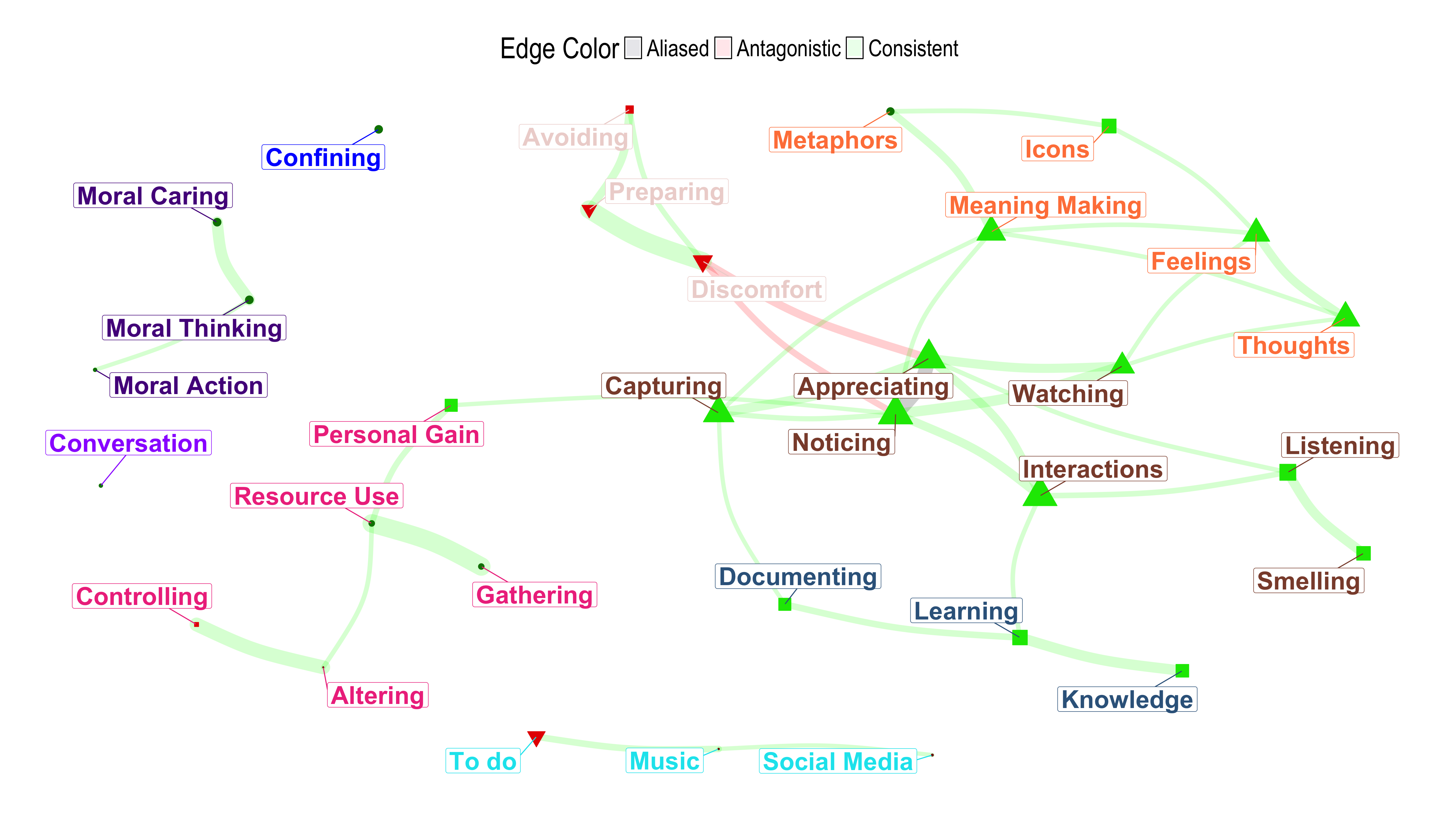
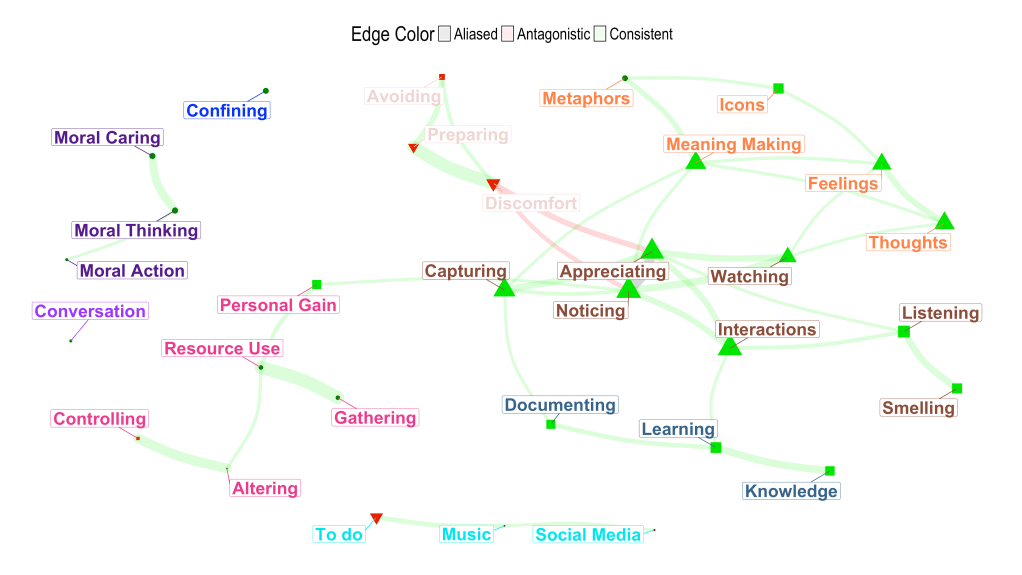
There was a cluster of activities we called Deliberate Engagement (Brown). This was formed from a blend of the sensory pathway (watching nature, listening to nature, and smelling nature), the beauty pathway (noticing, appreciating, and capturing nature’s beauty), and the emotion pathway (having meaningful interactions with nature).
There was another cluster of activities we called Meaningful Engagement (Orange). This was formed from a blend of the symbolic pathway (meaning-making, thinking about natural icons, and using nature-based metaphors) and the rest of the emotion pathway (having deep thoughts and feelings about nature).
Together, Deliberate and Meaningful Engagement were the two most influential clusters of emotions. Thus, like much other research—for example this paper—this highlights that connecting to nature is about more than simply being in nature; it really matters what you do in nature. And…it seems that the best things you can do in nature are (a) engaging its beauty with all of your senses and (b) reflecting on the emotions it makes you feel and on the meaning that it brings to your life (see this page for some of my experimental research on the latter).
The network also revealed a cluster that reflected the Scientific Pathway (steel blue). Like the original work, Scientific Engagement with nature was not the most impactful form of engagement and really only seemed useful to the extent that it can foster Deliberate and Meaningful engagement with nature. This is an interesting finding to note because it suggests that science education alone might not be enough to connect people to nature unless you build in elements of these other important forms of engagement.
Moral Engagement with nature (dark purple) and what we called Entitled Engagement (pink) with nature (altering or controlling nature, or using it for resources and personal gain) were not influential.
Finally, Dis-Engagement (pale brown) from nature (i.e., avoiding it, preparing for the negative parts of nature, and being uncomfortable in or around nature) was a notably negative pathway to nature connectedness. It is also worth noting that worrying about one’s to-do list had a negative impact on nature connectedness—so try to leave your proverbial to-do list at home when you spend time in nature.
Reference:
Lengieza, M. L., Richardson, M., & Aviste, R. (2024). Situation Networks: The emotions and activities that are central to nature-connectedness experiences. Journal of Environmental Psychology, 102491. https://doi.org/10.1016/j.jenvp.2024.102491
 MeaningInNature.com
Leave a comment